
Thursday, October 6, 2011

Absolute Religious Morality

The solution to morality’s incredible complexity is not to simplify and dumb down. Ignoring morality’s vast profoundness is a massive error. It would be nice if everything was absolute; if there were really black and white moral principles and ethics, but the high deviation of social moral norms tells us that absolute morality is wishful thinking.  I certainly share this wish, we would have less moral conflict, conflict in general really, and I wouldn’t have to think and write so much about this stuff, giving me more time to sell drugs, and sacrifice animals or whatever else we atheists do. But wishful thinking is not a logical argument; religion’s simplified morality is utterly wrong.

Religion became permanently frozen in the archaic Bronze Age with the Ten Commandments.  The Ten Commandments are an absolute joke as a moral guide. These ten rules stand above all other arbitrary religious restriction, because God himself felt they were important enough to physically write them on stone. Just think what good would have been possible for an omniscient creator. Think of all the unjustifiable crimes that could have been outlawed; genocide, slavery, rape, torture, cruelty, and human sacrifice. What a different story the bible would have been.

But no, instead Yahweh wasted four of the ten rules on his own vanity. Four rules for a God that can’t be harmed. Four rules wasted that could have done so much good for a morally primitive culture. God does not want us saying OMG, but sacrificing Isaac is cool. God cannot accept being a number two god, but raping your daughter is justifiable. Yahweh likes it when we take a day off to worship him, but stoning others for minor offenses was not worth his time to stop.

The next six are barely acceptable, only because some of the time lying, stealing, and murder do cause objective harm. However, war can be justifiable, deceiving to protect others is good, and stealing to feed your starving family is probably the right thing to do. But unfortunately consequentialist morality is too advanced for a barbaric god. If you are hiding children in your house, and lied to the nice Nazis, Yahweh is fucking pissed, and will get his nice chosen people to disembowel you or something.

The Ten Commandments is not only a failure of crappy rules, but is immoral for what hypothetical Yahweh did not say. This is a different argument from “why bad things happen?” because Yahweh is intervening in our world. The cop-out of God standing back to protect free will holds even less ground ; he is directly responsible for the moral code. Any harm that comes immediately after is a failure of the Hebrew God.

Wash your hands, sickness is actually caused by bacteria and viruses not evil spirits, and different genders are equal, don’t treat woman like shit. Do not worry so much about crimes without victims, tolerate others with different beliefs, do not go to war for stupid theology reasons; would be a few of the things that I would have thrown down to prevent future harm. But Yahweh did not, and the mass human suffering that has resulted from the inadequate Ten Commandments is 100 percent his fault. He chose to get involved with our world, and he did a shitty job.
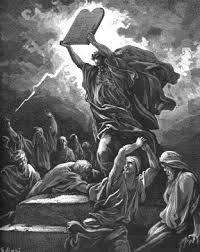
If Mount Sinai was just like any bible or religious teaching; my logical objections would still stand, but I would not be as angry. The Ten Commandments are taught to children as an absolute moral guide, it guides political leaders on the extreme right in our government, and there are still representations of it in government buildings; it affects me! The simplified morality shown in the Ten Commandments is used to make other moral decisions. Abortion is wrong black and white, cause god says so, homosexuality is wrong cause it’s a principle in the bible. No moral reasoning is being taught or used; black and white rules are simply regurgitated.

I do not understand why religions aversion to change is seen as a positive quality to religious people. We advance, we improve, and we increase our ability in moral understanding. Why do religions suppress this? To be fair, I do not think they really do because they will defend and rationalize biblical atrocities. This shows that moral reasoning interprets the bible, not the other way around, but my argument still stands because they think that the bible determines morality, and many theists mirror their judgment from it.

Please! We as human beings must advance our moral capacity. Religion does not have it right. It is simplified, black and white, and absolute. This simplification has done harm and is still currently harming others. The fear of moral relativism is irrational. Human beings in general want to be moral; we want to minimize harm and do good. Moral relativism is not a weak excuse to justify harming others. We need to break away from religion’s moral monopoly to begin our long, difficult, journey toward moral perfection.

Tuesday, October 4, 2011

The Useless and Abstract God Concept

The word “God” is tricky and can cause complications for both theists and atheist. It is an abstract concept without any solid definitions backing it up. It can be used for pantheism like Einstein, as a sense of wonder and immensity in the universe as for Stephen Hawking, or as the personal, loving caring God of monotheists. My concept of “God” is merely an idea, a social concept, but all of us are burdened with the broad inaccurate word, “God,” making our speech clumsy.

 Atheists deny the existence of “God.” But since the concept of God is so broad and abstract, I cannot logically deny all of these versions of God. Some of these new sacred canopies respond to the powerful force of empiricism by creating a God concept that is unfalsifiable.  Useful scientific theories must be falsifiable; there must be some kind of reality check. I cannot deny the existence of Bertrand Russell’s orbiting teapot. I cannot deny Pantheism or Deism and if everyone in our world had a belief like this, I would not be an active atheist. I would still think that some are inconsistent with reality, but these beliefs currently do little harm. But I can logically deny the personal, loving, powerful entity that directly interacts with our reality; the way monotheists define God.

One important step on my way out of religion and theism (I was raised Mormon) was Karen Armstrong’s book The History of God. She describes how people’s perception of God has changed drastically over time. Revision to the God concept was based on popularity, force, and theological debate, but it was never consistent for more than 300 years. Karen Armstrong was once a catholic nun, now she remains a theist; but barely. Her version of God is so diluted, reduced and non-personal that Richard Dawkins remarked that if she would describe god that way to any church congregation, they would call her an Atheist. Dawkins said, “They would be right.”

It is not useful to use these definitions of God. I do not care what a bunch of specialized theologians have come up with about Gods “true” nature. I care about the way average Americans and theists relate to the social concept of God.  I care about the way this harms, emotional abuses, and intellectually crushes average worshipers.

But while I deny the existence of a physical entity in our physical universe, God is real in a social sense. This god has real observable effects in my life and in my world. This concept has become real through social use. I have a few friends who fall into this unfalsifiable abstract god definition category. I complain about fundamental religions by saying that “God” expects this or says that. They will correct me by saying, “No, they think that is God. They think that that is what God is like, but they are wrong. I have the true understanding of God.” I think it is ironic that an atheist has a more useful, and concrete concept of God that has more of a basis for reality and objective evidence.

Don't edit this for your broadcast 
so it looks like I'm yelling, 'I killed
 Earl Milford!'-Gob Bluth 
There is nothing illogical about me and other atheists attacking “God” or being angry at “God.” God is real (I better not see that quote out of context somewhere). God affects my life; this social concept passes laws that affect me and attempt to influence my behavior. The American God is a real objective force, and I will write and be angry to defend myself and others from its harm.

Friday, September 30, 2011

Theist and Atheist Grief


All human beings in the world; Atheist, Christian, Muslim, and Jew, experience grief. It is a major part of our human experience. But the social way that grief is viewed and dealt with is unique to culture. Since the beginning of history, religion and mysticism have monopolized on this necessary function, and it still mostly remains in the powerful clutches of religion today. We human beings need explanation; it’s helpful to know that when shit happens there is a good reason for it. But this human desire does not go well with the human brain, which is irrational, and sees patterns and cause when none are there. Our brain is well adapted for survival, but not rationality.

Emotional pain is irrational. It makes sense that irrational ways of dealing with irrational pain would be the most popular. But popularity is not an argument for the best or the most beneficial. Theism and religion’s grief management style is archaic. I find the way that average theists deal with pain in everyday life to be emotionally harmful.

One of my coworkers and good friends recently caused a car accident. My friend was fine, but the other driver had severe medical issues and permanent damage. Although the accident was my friends fault (failure to yield), it could have happened to anyone. He felt horrible, and took a few days off to deal with the shock. I can only imagine the emotional sting he felt as he woke up each morning remembering the awful ordeal. The other guy’s mother was in the police station when my friend was there. She was furious and was yelling at the police officer asking why he had not been arrested.

Of course we can understand the pain this mother felt for the suffering of her son. It would be emotionally difficult. But this leads to my main point; when theists experience grief they are also weighed down with the additional pressure of figuring out why their misery is all part of God’s perfect plan. After heart wrenching grief, theists must justify their pain while protecting the assumption that God is all knowing, all powerful, and all good.

The only justification left is that the injury and agony are really good and they are part of Gods plan, ta da! And this is why I am angry enough to care. Are you fucking kidding me!?!?!?! The accident that my friend caused was good? All of his emotional pain and his heavy financial consequences were good?? My coworker and friend spent two years for God, he donates 10 percent of his tiny income for God, he takes a day off his busy schedule for God, and that’s how God repays him? And what about the victim and his mother? The accident will cause him to loose months away from school and work lying in the hospital with long term disability.  Is permanent damage and months of pain really the best way for an omniscient God to teach petty earth lessons?

Some will say that we only have a small picture, that we cannot understand the lessons God wants for us. It is out of our cognitive reach. Everything is in Gods blueprint. It is good because God made it. In moral arguments the end rarely justifies the means. Why is it acceptable for God? Why is he not called a sadist?

And just to be clear, I am an Atheist. I am not really angry at an old white man with a beard above me. I am angry at religion, and the social concept of God. To me that is all God is, a social idea. And yes, I am damn mad at that.

Atheists experience grief better; it still hurts, and it is still painful, but we do not have the additional burden of justification. When shit happens, we know there is no reason. There is no grand, perfect plan where your misery is required; and no supernatural, all powerful, being is watching you suffer. It just sucks. And that acceptance, I find very peaceful and liberating in the face of grief.

So much of my anger toward Christianity and religion involves offensive ways for justification. Justifications are religions only defense barrier. For centuries Christianity has been fighting the battle against empiricism. Each time a supernatural explanation is replaced by a natural one, religion loses ground. Christianity fights back with justification. No matter what happens in our physical world it is proof for religion’s supernatural claims. This defense works; religion is still around, but the good, average theists are the collateral damage.
Yes I am angry, just like
the Angry Birds


I am angry because a car wreck is evidence for a loving God. I am angry because theists must work their brains in circles to maintain faith when they should just feel comfort from friends and loved ones. I am outraged that horrible suffering must be called good to protect the holiness of Yahweh’s name. And I am pissed that theists feel unnecessary emotional pain because religion says it proves their claim.